
As AI pushes data centre power demand to new extremes, access to electricity is becoming the industry’s biggest bottleneck. We explore how vanadium flow batteries can turn limited power into greater computing capacity.
Steady growth in data centre capacity has been a hallmark of the last decade, but the recent rise of generative AI has drastically altered the trajectory of power demand from these facilities. From Silicon Valley to Northern Virginia, across the accelerating markets of the UK, Europe and Asia, the race is on to build the massive Graphics Processing Unit (GPU) clusters required to train and run the next generation of AI.
But as demand for compute surges and capital pours into the sector, data centre developers are hitting an invisible wall: power availability. This challenge goes beyond securing power; it’s about maximising the amount of compute that limited power can support. The questions for developers are not just “how do I get more megawatts?” but also “how do I get more computing output from the megawatts I have?”
With AI training clusters growing from the tens of megawatts towards gigawatt scale, the size and volatility of their electrical demand is challenging traditional data centre design and straining regional transmission systems. Utilities, governments, and grid operators are increasingly pushing responsibility for solving this imbalance back onto developers. In Ireland, new datacentres must provide on-site generation or storage equal to their full requested import capacity. Governors in Pennsylvania, New Jersey, Maryland and Virginia have proposed making “bring your own generation” a formal requirement.
Where does this leave datacentre developers? Most see energy storage as an essential part of the solution to overcoming limited connection capacity and optimising on-site generation, but also recognise that not all storage technologies are the same. For those looking to maximise the amount of computing power they can put on site, Vanadium Flow Batteries (VFBs) can be a game changer.
Why AI Data centre Power Loads are Different
Traditional data centre loads have been largely based on general-purpose Central Processing Units (CPUs), which exhibit relatively flat power profiles with minor variations throughout the day.
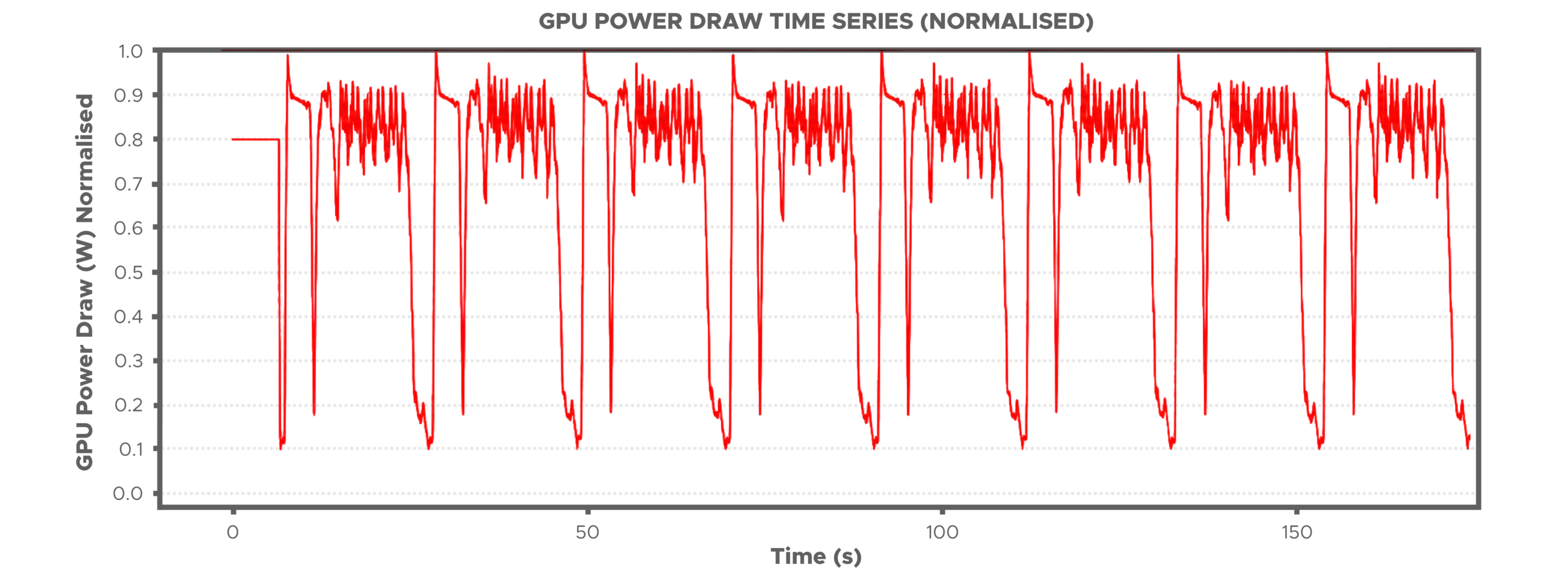
AI training is different. It operates under a “bulk synchronous” paradigm where tens of thousands of GPUs work in lockstep, synchronising at regular intervals and creating much larger power swings. During a typical training iteration, these processors cycle between computation-heavy phases during which they are processing data, and communication-heavy phases during which they pause their calculations and synchronise what they’ve learned with each other.
In the computation phase power draw hits its peak; during the communication phase, it can drop to near-idle levels. As thousands of GPUs ramp up and down in unison, they create massive, sharp-edged power swings that can move from 10% to 90% of peak load within milliseconds.
These power swings often reach multi-megawatt levels, occurring hundreds of times per day. For a grid operator, this is the equivalent of a massive industrial plant switching on and off every few seconds.
Figure 1: GPU load swings of an at-scale training job (Adapted from Microsoft)
Using Storage to Solve the Grid Connection Dilemma
This volatility creates a massive headache for grid operators and developers. Grid connections or on-site generation must be sized to meet the instantaneous peak demand seen during the computation phases, rather than average consumption. But because the ratio between peak and average power during AI training can range from 4:1 to 9:1, most AI campuses operate with significant headroom that goes largely unused.
The consequences of this mismatch are severe:
- Time-to-Power Delays: Large clusters face years-long waits in interconnection queues because the grid cannot support their theoretical peak load.
- Inflated Costs: Developers pay for massive grid connections and/or on-site electrical infrastructure that is only fully used a fraction of the time.
- Systemic Risk: Grid operators have warned that sudden, large-scale ramp-down events from AI clusters can cause frequency instability and risk mechanical failure in upstream turbine generators.
To overcome this, developers are increasingly turning to energy storage—not just as backup, but as an active component of their power architecture.
A battery placed between the grid connection and the GPU load can discharge power during the computational peaks, and charge during the communications lulls. This flattens the load profile, allowing interconnections or on-site generation to be sized to accommodate the average load instead of the much higher peak.
In effect, the battery absorbs excess power when demand is low and releases it when demand spikes—acting as a shock absorber between the power source and the data centre.
Unlocking “Compute Uplift”
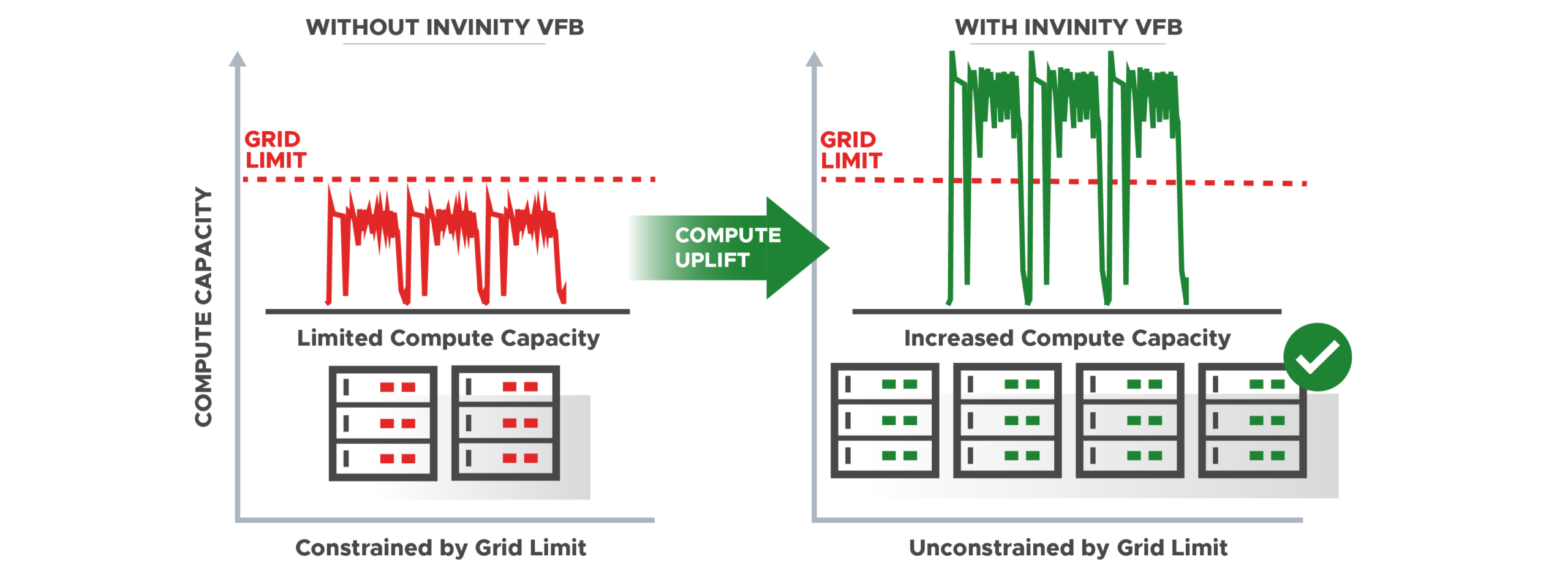
Faster grid connections and lower capital costs are big wins for developers, but the most compelling commercial advantage of adding suitable energy storage is its ability to enable compute uplift. In other words: deploying more GPUs—and therefore more revenue-generating compute—within the same constrained power envelope.
For example, a UK AI campus with a 120 MW peak load but a 20 MW average load could potentially support its entire cluster on a 60 MW grid connection if supplemented by a VFB buffer. In this scenario, the VFB delivers a 2x compute uplift, effectively doubling the computing capacity of the site without increasing its grid connection. In a market constrained by power availability and long permitting delays, the ability to go beyond the limits of site capacity is a game-changer.
Figure 2: “Compute Uplift” can be achieved by leveraging VFBs at datacentres
Why Lithium Gives Us the Jitters
While lithium-ion (particularly LFP) batteries are widely deployed in traditional Uninterruptible Power Supply (UPS) applications, they are ill-suited for the high-frequency “jitter” of an AI training workload, which presents a fundamentally different challenge. Recent research highlights how LFP systems are sensitive to frequent State-Of-Charge (SOC) changes and high-frequency cycling. These systems typically operate within a narrow usable SOC window (often 10–90%) to preserve their lifespan. In a high-utilisation environment like an AI data centre, this limited range becomes a bottleneck for reliability.
The operational risk is that the repeated partial cycling and irregular current waveforms required to “smooth” an AI load could accelerate the LFP degradation through capacity fade and rising internal resistance.
To survive such a punishing duty cycle, a lithium-ion system would need to be significantly oversized and derated, leading to larger footprints, increased capital costs, and higher thermal stress. Furthermore, data centre operators and their insurers often see the flammability of on-site lithium as a cause of heightened risk, particularly given the massive capital investment in the nearby GPU arrays.
The Vanadium Flow Advantage
Vanadium Flow Batteries offer a fundamentally different performance profile.
Put simply, they are non-flammable and don’t degrade with each cycle. Using a fully-reversible chemical reaction that occurs entirely in the liquid phase, they avoid the physical stresses and failure modes that cause degradation—or worse, fires—in LFP cells. These characteristics directly address the core challenges created by AI training loads: high-frequency cycling, large power swings, and the need for constant availability.
This gives AI datacentre developers several decisive advantages:
- Unlimited Cycling: VFBs can cycle continuously and deeply, hundreds of times a day, without any loss of capacity or power output over 30+ years. This perfectly matches the seconds-to-minutes variability of AI training iterations.
- Full Range Usability: Unlike Lithium, VFBs maintain full power output across their entire state-of-charge range. This gives operators the certainty that their “buffer” is always ready, regardless of how much energy is currently stored.
- Safety and Sustainability: VFBs use a non-flammable electrolyte, eliminating the risk of thermal runaway, a critical factor for high-density hyperscale facilities.
Conclusion: Vaulting Over the Power Barrier
Power availability and stability are no longer niche technical concerns; they are the primary bottleneck to scaling AI infrastructure. Developers relying on traditional architectures will face escalating costs and constrained growth. By integrating Vanadium Flow Batteries at the heart of the datacentre power architecture, operators can protect the grid, eliminate the “peak-to-average” penalty, and deploy more processing power at a scale and speed that was previously impossible.
As AI clusters continue to grow, the winners will be those who treat energy storage not just as an insurance policy, but as a strategic enabler of compute capacity.
Ready to see how vanadium flow can unlock more compute at your datacentre facility? Contact our team today.