
Power Your Data Centre Without Waiting for the Grid
Milliseconds response. No thermal runaway. Proven at GWh scale.
Lithium-ion batteries derate under load and carry fire separation requirements that push them away from critical infrastructure. Invinity’s vanadium flow batteries deliver full power at any state of charge and sit safely next to your data centre.
Because of our advantages over lithium-ion for data centres, we were chosen to build the world’s largest flow battery – a 1.5 GWh system for a technology campus and AI data centre in Laufenburg, Switzerland.
Talk to a data centre energy storage expert to:
/ Learn how on-site storage gets your data centre to power faster
/ Learn how peak shaving and load shifting unlock more compute on a smaller grid connection
/ See system specifications and typical site layouts
/ Learn if Invinity’s batteries are a fit for your data centre
Call today to talk to an energy storage expert.
UK/EMEA: +44 204 526 5789
N.Am/APAC: +1 510 306 2638
Send us a message and an energy storage expert will follow up with you promptly.
"*" indicates required fields
Built to Handle What Lithium-Ion Can’t
Handles rapid load swings: AI training clusters swing tens of megawatts in seconds. Invinity’s flow batteries respond in milliseconds and deliver full output at any state of charge, with no derating as the system discharges.
Improves power quality: Volatile compute loads push harmonics back into your distribution system. Combined with a PCS, Invinity systems condition the power they deliver.
Works with your existing generation: Invinity absorbs the transients that generators handle badly, reducing wet stacking, cycling wear, and the fuel burned holding spinning reserve for load that arrives in bursts.
Safe to sit near the data centre: The electrolyte is aqueous and non-flammable, with no thermal runaway pathway. This affects separation and suppression requirements under NFPA 855.
Costs less over thirty years: A lithium system sized for data centre loads is out of warranty at around year 11, and the replacement happens in a live facility. Invinity batteries have no cycling limits and no capacity fade. Run them hard, at any state of charge, every day for three decades. A single VFB delivers more than 3x the lifetime throughput of a comparably-sized lithium battery.
Cumulative Energy delivered over time

Invinity has proven to be the strongest partner by presenting the most compelling overall package with the lowest life-cycle costs (LCOS). Invinity’s vanadium flow technology is perfectly suited for our project due to its safety – particularly its non-flammability – its cycle stability, and its flexibility in application.
Why We're the Top Storage Choice for Data Centres
Safest: The non-flammable, water-based vanadium electrolyte can’t thermally run away, giving it a far lower fire risk than other containerised batteries sited near compute.
Longest Life: Our VFB batteries run for up to 30 years with unlimited daily cycling and no capacity degradation, built for a data centre’s around-the-clock duty cycle.
Lowest Cost per MWh: Massive throughput and no marginal cycling costs give Invinity’s batteries the lowest price per MWh stored and discharged over the product’s lifetime, lowering your data centre’s energy cost at scale.
Proven: Deployed around the world across the most demanding energy storage applications, Invinity has been selected to design the world’s largest flow battery; a 1.5 GWh system at a critical Swiss data centre, bringing that proven reliability to the sector.
Free Yourself from Grid Constraints
Data center developers are increasingly required to “bring your own power” in order to secure a grid connection or avoid curtailment. For many, that means co-located solar and wind which provide clean, cost-effective—but intermittent—power. Invinity’s proven and performing vanadium flow batteries (VFBs) are an ideal pairing with on-site renewables. With an exceptional safety profile and no cycle-driven degradation, they can smooth and shift variable renewable power to make it available when it’s needed, while providing continuous high-frequency buffering required for today’s volatile AI learning data centre loads.
While lithium-ion systems are optimised for short-duration backup and once-a-day cycling, Invinity VFBs will continue to provide you flexible and uncompromised high-throughput performance over their entire 30+ year lifespan:
- Secure firm power from renewables & avoid curtailment
- Faster permitting with no fire risk
- Improve power quality and support grid stability
- Provide critical backup in the event of grid outages

Above: Firming intermittent renewable power for data centre loads using energy storage.
Turn Power Constraints into Compute Advantage
AI data centre loads create sharp swings in power load, forcing operators to size their infrastructure for peak demand rather than typical usage, leading to oversized grid connections, underutilised capacity and delayed deployments. Invinity’s non-degrading vanadium flow batteries provide a new way forward: sitting between the grid connection and the load, they allow developers to optimise for a smaller grid connection by supplying power during peak compute cycles, absorbing excess during idle periods, and smoothing highly volatile power profiles.
By flattening power demand, flow batteries allow operators to deploy significantly more compute within existing electrical limits:
- Operate closer to average load at constrained sites
- Dramatically reduce grid connection sizes and costs
- Deploy capital faster without waiting for grid expansion
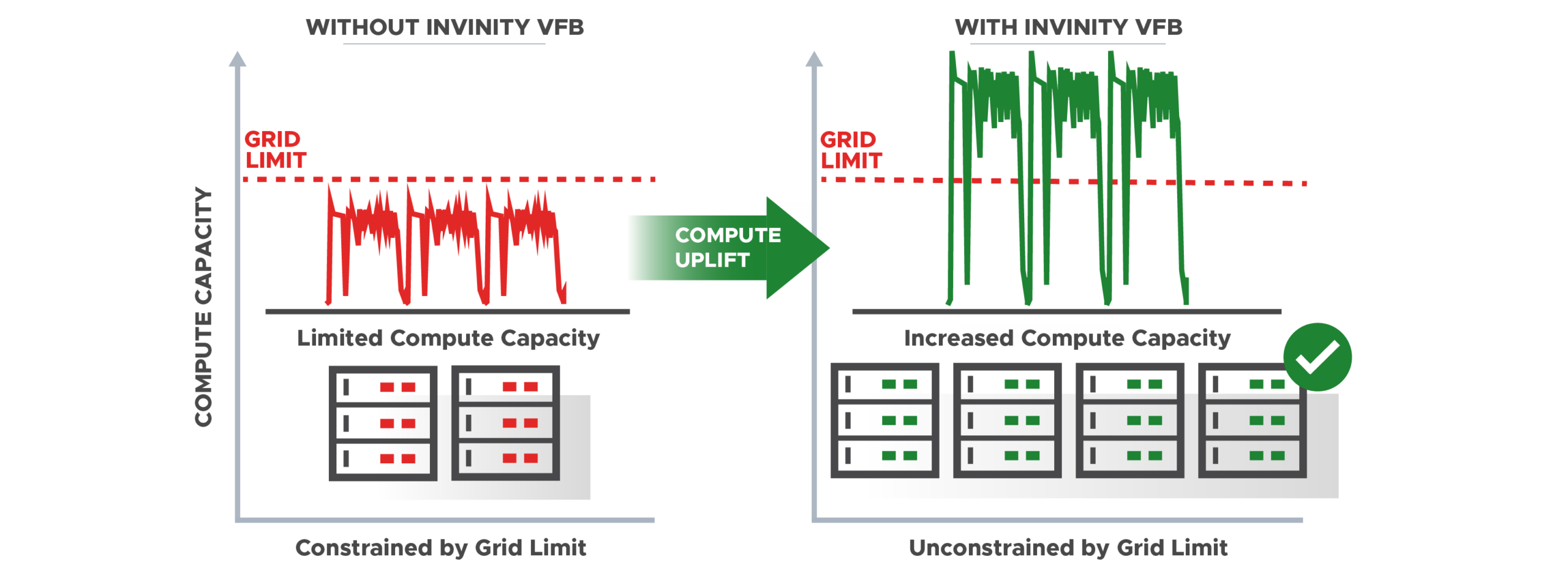
Above: Invinity battery storage enables compute uplift by adding a higher number of GPUs.
Are you in the process of developing a data center?
Build without power constraints. Contact us to discuss the details of your project and discover how Invinity can help you unlock more compute, faster.
Frequently Asked Questions
What's the difference between vanadium flow batteries and lithium-ion for data center backup power?
Vanadium flow batteries decouple power and energy capacity and deliver full rated power regardless of state of charge, using a non-flammable aqueous electrolyte. Lithium-ion uses a flammable chemistry and loses capacity every cycle. For a system running continuous daily cycling, that’s the difference between predictable, unchanging performance and a battery that degrades under the exact duty cycle a data center puts it through.
Are vanadium flow batteries safer than lithium-ion for use near data center compute infrastructure?
Yes. The electrolyte is non-flammable and non-explosive, eliminating the thermal runaway risk lithium-ion carries. That changes fire suppression requirements, insurance underwriting, and how close the system can sit to critical compute load.
What is the total lifecycle cost of vanadium flow storage vs. lithium-ion over a data center's operating life?
Has vanadium flow battery storage been selected for a large-scale data center deployment?
Can battery storage let a data center minimize grid interconnection delays with the utility company (battery + solar)?
Can battery storage let a data center minimize grid interconnection delays with the utility company (battery only)?
How does battery storage increase usable compute capacity for a fixed grid connection?
Additional Resources & Publications
Related Posts
Third Party Publications
Our Customers


Faster to Power
Get to power sooner. Because they’re non-flammable and can’t thermally run away, Invinity’s batteries clear the fire code and siting hurdles that stall other battery systems near critical load.
Scales With Your Build-Out
Modular, stackable, and fully scalable, Invinity’s batteries size from a single hall to a full campus and grow as your compute load and power demand do.
Run It Hard, Every Day
Cycle it every day for peak shaving and load shifting. With no warranty limit on cycling and no degradation, the system keeps delivering value as your data centre grows.